
Key Takeaways
-
AI-powered search engines like Google AI Mode, ChatGPT Search, and Perplexity now generate direct answers and summaries that bypass traditional blue-link results, making it essential to optimize for AI citations rather than just keyword rankings.
-
Structure content to answer questions directly in the first 2-3 sentences using FAQs, bullet points, numbered lists, and clear definitions formatted for AI systems to easily parse and extract.
-
Build topical authority by creating a library of interconnected content covering your subject from multiple angles rather than publishing isolated articles, as AI systems favor sources demonstrating deep expertise.
-
Implement schema markup (FAQ, Local Business, Article, Review, How-To) to provide machine-readable context that helps AI systems understand and cite your content more precisely.
-
Strengthen E-E-A-T signals through author credentials, customer reviews, case studies, backlinks from reputable sources, and consistent factual accuracy to increase likelihood of appearing in AI-generated summaries.
-
Optimize for conversational and natural language queries by incorporating full questions (e.g., ‘What are the best SEO services for small businesses in Tampa?’) instead of just keywords, matching how users interact with AI search.
Search has changed dramatically. In 2026, artificial intelligence now powers the way people find information online. Traditional SEO tactics still matter, but they are no longer enough on their own. If your business wants to stay visible, you need to understand AI search engine optimization — and how to apply it effectively.
AI-driven search tools like Google’s AI Mode, ChatGPT Search, and Perplexity AI are reshaping how users discover businesses. These platforms do not just rank pages. They generate direct answers, recommend trusted sources, and summarize information in ways that bypass traditional blue-link results entirely. That means your content strategy must evolve to meet these new demands.
This guide breaks down seven proven strategies to help your business get found, cited, and recommended by AI-powered search engines. Whether you run a local service business or an e-commerce store, these tactics will help you compete in the new era of search. Let’s dive in.
What Is AI Search Engine Optimization?
AI search engine optimization is the process of making your website and content more visible within AI-generated search results. It goes beyond traditional keyword targeting. You are now optimizing for language models that evaluate trust, authority, and relevance in a much more nuanced way.
Understanding how AI search algorithms actually work is the first step. These systems do not simply match keywords. They analyze context, intent, and credibility. If your content clearly answers questions and demonstrates expertise, AI engines are far more likely to surface it.
Strategies like Answer Engine Optimization (AEO) and Generative Engine Optimization (GEO) have emerged alongside traditional SEO. Together, these approaches form a complete framework for modern search visibility. You can learn more about what AEO means in digital marketing and why it has become essential in 2026.

Why AI Search Optimization Matters for Your Business
AI-powered search is not a future trend. It is already the dominant reality. Google reports that AI Overviews now appear in a significant share of search queries, and platforms like ChatGPT receive hundreds of millions of searches every month.
Businesses that adapt early gain a major competitive advantage. Those who ignore this shift risk losing organic visibility even if their traditional SEO rankings hold steady. The reason is simple: AI summaries often satisfy the user’s query without a single click to your site. You need to be the source those AI tools cite. Research on LLM-referred traffic shows conversion rates of 30–40% — making this an opportunity no business should ignore.

7 AI Search Engine Optimization Strategies That Drive Results
1. Optimize Content for Direct, Clear Answers
AI search engines reward content that answers questions directly and concisely. Structure your pages around specific questions your audience asks. Then answer those questions in the first two to three sentences of each section.
Use formats that AI tools can easily parse and extract. This includes:
- Short, declarative answers at the top of each section
- FAQ-style content with clear question-and-answer pairs
- Bullet points that summarize key takeaways
- Numbered lists for step-by-step processes
- Definitions written in plain, accessible language
This approach aligns with Answer Engine Optimization best practices, which are now a core component of any serious AI SEO strategy. The clearer your answers, the more likely AI engines are to quote and cite your content.
2. Build Topical Authority With Depth and Consistency
AI models favor sources that demonstrate deep expertise in a specific area. Publishing one article on a topic is not enough. You need to build a library of content that covers your subject from multiple angles.
This concept is known as topical authority. When AI systems see that your website consistently covers a topic thoroughly, they treat it as a reliable reference. This increases the likelihood that your content will be cited in generated responses.
Here is a simple framework for building topical authority:
- Identify your three to five core subject areas
- Create a pillar page that covers each topic broadly
- Build supporting articles that address specific subtopics
- Link all related articles together internally
- Update and expand content regularly to stay current
3. Prioritize E-E-A-T Signals Across Your Website
Google’s E-E-A-T framework (Experience, Expertise, Authoritativeness, and Trustworthiness) has become even more critical in the age of AI search. AI systems use these signals to determine whether a source deserves to be cited and recommended.
To strengthen your E-E-A-T signals, focus on the following:
- Publish author bios that highlight real credentials and experience
- Earn backlinks from reputable websites in your industry
- Display customer reviews, case studies, and testimonials
- Keep your content factually accurate and regularly updated
- Secure your website with HTTPS and maintain a professional design
Businesses with strong E-E-A-T profiles are significantly more likely to appear in AI-generated summaries and featured snippets. This is not optional — it is foundational to AI search engine optimization in 2026.
4. Implement Structured Data and Schema Markup
Structured data helps AI and search engines understand your content more precisely. By adding schema markup to your pages, you provide machine-readable context about your business, services, products, and content.
Key schema types to implement include:
- FAQ Schema — Helps AI extract question-and-answer content
- Local Business Schema — Signals your location and service area
- Article Schema — Identifies editorial content and authorship
- Review Schema — Surfaces star ratings in search results
- How-To Schema — Structures step-by-step instructional content
Schema markup is one of the most direct technical signals you can send to AI search systems. If your website currently lacks structured data, this is a high-priority fix. You may want to explore a professional SEO audit service to identify these gaps quickly.
5. Produce High-Quality, Long-Form Content That AI Can Reference
AI language models are trained on high-quality written content. When your website publishes detailed, well-researched articles, you increase the chance that AI tools will learn from and reference your work in generated responses.
Long-form content of 1,500 words or more tends to perform better in AI search contexts. This is because longer articles typically cover a topic more thoroughly, giving AI systems more material to extract and summarize. Our content writing services are designed specifically to produce this type of authoritative, AI-friendly material for your brand.
Content that AI tools are most likely to cite shares several common traits:
- It answers a clear, specific question
- It includes data, statistics, or expert insights
- It is written by an identifiable human author with real credentials
- It uses clean formatting with headers, lists, and tables
- It avoids vague or overly promotional language
6. Optimize for Conversational and Voice Search Queries
People interact with AI search differently than they do with traditional search engines. Instead of typing two or three keywords, they ask full questions in natural language. Your content needs to reflect this shift.
Incorporate conversational phrases and long-tail questions into your content strategy. Think about how a customer would actually ask a question aloud, and then write content that answers it directly. This is how you align with the way AI interprets and processes search queries.
| Traditional Search Query | AI/Conversational Query |
|---|---|
| SEO services Tampa | What are the best SEO services for small businesses in Tampa? |
| Google Ads cost | How much should I spend on Google Ads each month for my business? |
| website designer near me | Who is the best website designer near me for a small business? |
| local SEO tips | How do I improve my local SEO rankings in 2026? |
Adapting your keyword strategy to include these natural language queries is one of the most effective ways to capture AI search traffic. For a deeper dive, explore 10 ways to optimize for AI search results in 2026.
7. Strengthen Your Brand Presence Across Multiple Platforms
AI search engines do not rely solely on your website. They pull data from across the web to build a picture of your brand’s authority and trustworthiness. A strong multi-channel presence sends powerful signals that reinforce your credibility.
Key platforms to maintain an active presence on include:
- Google Business Profile — essential for local visibility and AI citations
- Social media channels, including our active profiles on Instagram and Facebook
- Industry directories and citation sources
- Review platforms like Google, Yelp, and industry-specific sites
- LinkedIn and professional networks for B2B authority building
Consistency is critical. Your business name, address, phone number, and website URL must match exactly across all platforms. AI systems cross-reference this data when evaluating credibility. Visit Brain Buzz Marketing on Google to see an example of a well-maintained local business profile that supports strong AI search visibility.
Comparing Traditional SEO vs. AI Search Optimization
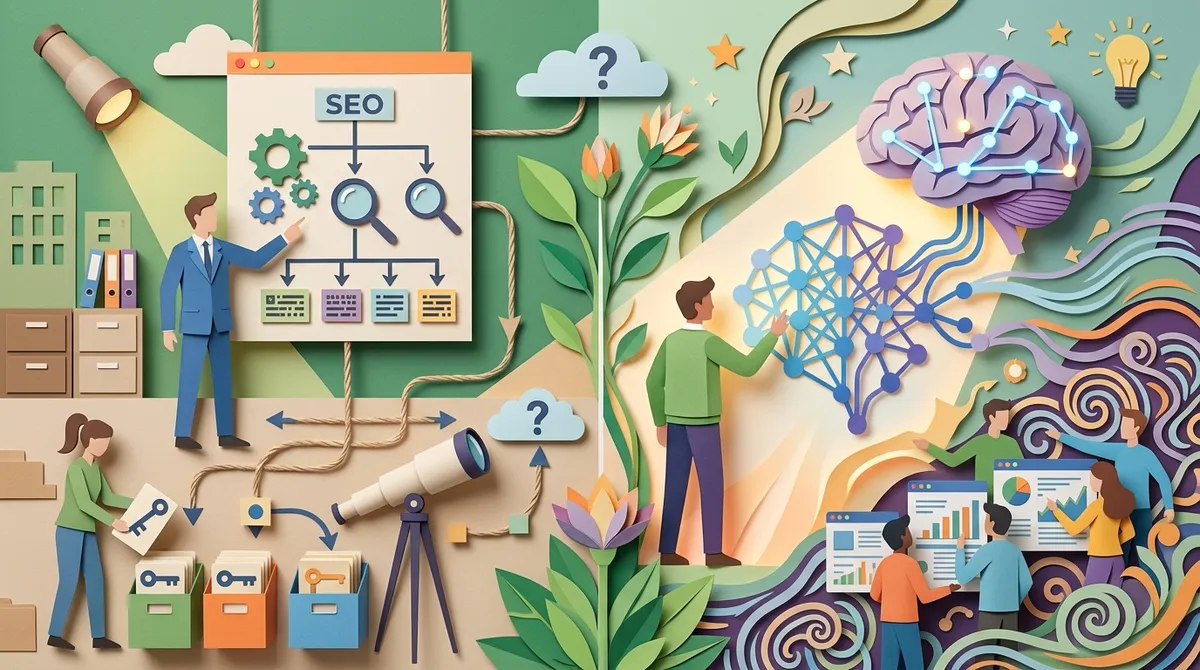
Understanding the differences between traditional SEO and AI search engine optimization helps you allocate your efforts strategically. Both approaches complement each other, but they require distinct tactics.
| Factor | Traditional SEO | AI Search Optimization |
|---|---|---|
| Primary goal | Rank in blue-link results | Get cited in AI-generated answers |
| Content style | Keyword-focused | Answer-focused and conversational |
| Authority signals | Backlinks and domain authority | E-E-A-T, brand consistency, structured data |
| Technical focus | On-page optimization, site speed | Schema markup, structured content |
| Measurement | Keyword rankings, organic traffic | AI citations, LLM-referred traffic, brand mentions |
The most effective digital marketing strategies in 2026 combine both approaches. You can explore the full picture in our guide on SEO vs. AEO: which strategy wins for your business.
How Brain Buzz Marketing Approaches AI SEO
At Brain Buzz Marketing, we have been helping small and medium-sized businesses grow their online presence since 1998. Our team specializes in SEO, GEO, and AEO content strategies that are built for the modern search landscape — not just traditional Google rankings.
We write content that satisfies both human readers and AI language models. Every article we produce is structured to answer real questions, demonstrate genuine expertise, and earn citations from AI-driven platforms. Our SEO services are fully updated to reflect the demands of AI search engine optimization in 2026. If you want content that gets your brand recommended by AI, reach out to our team to get started with a consultation.
Key Metrics to Track for AI Search Performance
Measuring success in AI search requires tracking different metrics than traditional SEO. Here are the most important indicators to monitor:
- LLM-referred traffic — Visits from AI platforms like ChatGPT and Perplexity
- AI Overview appearances — How often your content appears in Google AI Overviews
- Brand mention volume — How frequently your brand is cited across AI-generated content
- Featured snippet capture rate — The percentage of your pages that earn featured snippets
- Organic click-through rate — Whether AI-visible content is driving actual visits
- Conversion rate from AI referrals — The quality and intent level of AI-driven visitors
Tracking these metrics alongside traditional SEO data gives you a complete picture of your digital visibility. Our analytics and reporting services help businesses make sense of this evolving data landscape with clarity and precision.
Conclusion
AI search engine optimization is no longer a niche tactic for tech-savvy marketers. It is now a core requirement for any business that wants to remain visible online in 2026. The seven strategies outlined in this article — from building topical authority to optimizing for conversational queries — give you a clear roadmap for adapting to this new reality.
The businesses that invest in AI-focused content strategies today will be the ones that dominate search tomorrow. Whether you are a startup building your first website or an established local service provider looking to expand your reach, AI search optimization offers measurable, sustainable growth. For more proven tactics, explore our resource on 9 key strategies for AI search optimization in 2026.
Ready to take the next step? Our team is here to help you build a content and SEO strategy that earns real visibility in AI-powered search. Reach out to our team today and let’s build a strategy that positions your business for long-term digital growth.
FAQs
Q: What is AI search engine optimization and how does it differ from traditional SEO?
A: AI search engine optimization is the practice of structuring your website and content so that AI-powered platforms — such as Google AI Mode, ChatGPT Search, and Perplexity — cite and recommend your business in their generated responses. Unlike traditional SEO, which focuses primarily on ranking in blue-link results through keyword placement and backlinks, AI SEO emphasizes clear answer formatting, topical authority, E-E-A-T signals, and structured data that AI models can extract and reference directly.
Q: How long does it take to see results from AI search optimization?
A: Results from AI search engine optimization typically begin to appear within three to six months of consistent effort. Building topical authority, earning credible backlinks, and producing high-quality structured content all take time to be recognized by AI systems. Businesses that publish regularly, maintain accurate brand profiles across platforms, and implement schema markup tend to see faster progress in AI citation rates and LLM-referred traffic.
Q: Do small businesses need AI search engine optimization in 2026?
A: Absolutely. AI-powered search tools are now used by a large and growing share of consumers at every stage of the buying process. Small businesses that optimize for AI search gain visibility in front of high-intent audiences who are actively seeking solutions. Ignoring AI SEO means risking significant loss of organic visibility, even if your traditional search rankings remain stable.
Q: What types of content perform best in AI search results?
A: Content that directly answers specific questions, demonstrates genuine expertise, and uses clean structural formatting — such as headers, bullet points, numbered lists, and FAQ sections — performs best in AI search contexts. Long-form articles of 1,500 words or more, supported by schema markup and clear author credentials, are most likely to be cited by AI language models and featured in AI-generated summaries.
Q: Is AI search optimization replacing traditional SEO entirely?
A: No. AI search engine optimization complements traditional SEO rather than replacing it. Both disciplines share foundational elements such as high-quality content, strong site architecture, and authoritative backlinks. The key difference is that AI SEO adds additional layers — including answer-focused writing, structured data, and multi-platform brand consistency — that help your content get discovered and cited within AI-generated responses alongside traditional organic rankings.
Our Service Area