
Key Takeaways
-
AI search tools now generate direct answers instead of ranking web pages, making GEO essential—if your business isn't cited in AI-generated responses, you're losing customers who never see traditional search results.
-
GEO requires clear, direct answers in the first few sentences, structured data/schema markup, and strong topical authority, whereas traditional SEO emphasizes keywords and backlinks—focus on both layers for maximum visibility.
-
AI models prioritize content that directly answers specific questions with clear formatting, author expertise aligned with E-E-A-T guidelines, and consistent business information across all platforms to determine trustworthiness.
-
Start optimizing for AI search by auditing existing content clarity, adding upfront answers to common questions, implementing schema markup, and maintaining consistent business details everywhere online.
-
Small businesses, e-commerce retailers, local service providers, and startups benefit most from GEO strategies now, as more users adopt AI search tools for recommendations and local service discovery daily.
-
Avoid vague content, ignoring structured data, neglecting business profile updates, publishing content once, and scattering inconsistent business details—quality, genuine content that answers real questions still wins with AI models.
Remember when getting to page one of Google felt like winning the lottery? Well, grab a seat, because the search game just changed again. Now people ask ChatGPT, Google AI Overviews, and Perplexity their questions instead of typing them into a search bar. If your business isn’t showing up in those AI answers, you’re missing out on customers who never even see a traditional search result. That’s where generative engine optimization comes in, and trust us, it’s a lot friendlier to learn about than it sounds.
At Brain Buzz Marketing, we’ve watched search evolve for decades, and we’re genuinely excited about this next chapter. Whether you run a small shop in Tampa or manage marketing for a growing e-commerce brand, understanding this shift can help you stay ahead. Let’s break it down together, nice and simple.

What Is Generative Engine Optimization?
Generative engine optimization, often called GEO, is the practice of optimizing your online content so AI tools can find it, understand it, and recommend it. Think ChatGPT, Google’s AI Overviews, Perplexity, and other AI-powered search tools. Instead of just ranking in a list of blue links, your goal is to become the answer these tools give people.
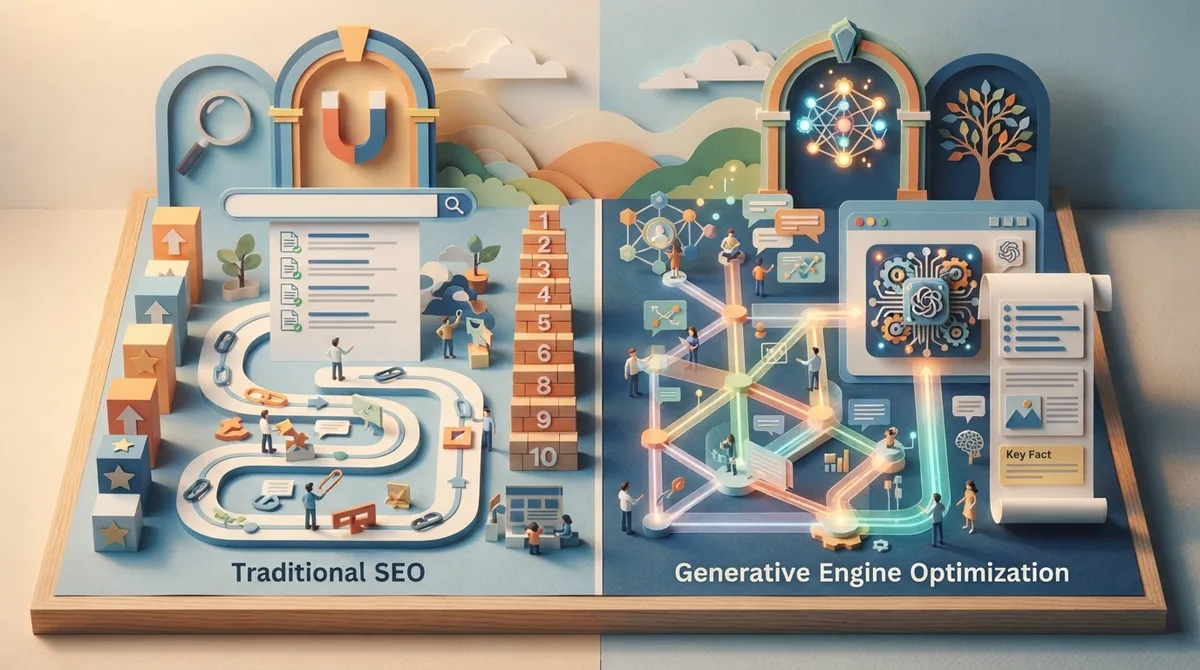
Traditional SEO focuses on keywords and backlinks to climb search rankings. GEO focuses on something a little different: making your content clear, trustworthy, and easy for an AI model to summarize. These AI engines pull information from across the web, digest it, and generate a direct answer for the user. If your website is the source they trust, you get the credit, the click, and often the customer.
Why This Matters Right Now in 2026
AI search adoption has exploded. People are asking questions in full sentences and getting instant answers without ever clicking through to a website. This is sometimes called a zero-click search. It sounds a little scary if you’re used to counting website visits, but it’s actually a huge opportunity. If your business gets mentioned by name in an AI answer, that’s priceless exposure, kind of like getting a personal recommendation instead of just being listed in a directory.
Our team has been tracking this shift closely, and we’ve written more about it in our deep dive on optimizing content for AI-driven search engines. It’s worth a read if you want the full picture.
How Generative Engine Optimization Differs From Traditional SEO
You don’t need to throw out your old SEO strategy. Think of GEO as a new layer on top of it. Good SEO habits like fast page speed, mobile-friendly design, and quality backlinks still matter. But GEO adds a few new priorities to the mix.
| Factor | Traditional SEO | Generative Engine Optimization |
|---|---|---|
| Goal | Rank high on search results page | Get cited or quoted in AI-generated answers |
| Content Style | Keyword-focused, long-form | Clear, direct answers with structured facts |
| Key Signals | Backlinks, keyword density | Clarity, authority, structured data, citations |
| User Behavior | Click through to website | May get answer without visiting site |
| Success Metric | Rankings and traffic | Brand mentions and AI citations |
If you’re curious how these two approaches stack up in more detail, check out our article on SEO vs. AEO and which strategy wins for your business. It covers a lot of the same ground from a slightly different angle, since AEO and GEO are close cousins in the AI search world.
Answer Engine Optimization vs. Generative Engine Optimization
You may have also heard the term AEO, or answer engine optimization. These two terms get used together a lot, and honestly, there’s a lot of overlap. AEO usually refers to optimizing for direct answer boxes and voice search. GEO is a bit broader, covering how AI models generate entire responses using content from many sources at once.
For small business owners, the practical advice is the same either way: write clear, honest, well-organized content that answers real questions people are asking.

How Do AI Search Engines Actually Choose What to Show?
Great question, and one we get all the time. AI search tools scan huge amounts of web content, then use algorithms to figure out which sources are trustworthy, relevant, and well-organized. Here’s a simple breakdown of what they tend to favor:
- Content that directly answers a specific question in the first few sentences
- Clear formatting with headers, lists, and short paragraphs
- Author expertise and trustworthy sources (this ties back to Google’s E-E-A-T guidelines)
- Structured data, like schema markup, that helps machines understand your content
- Consistent information across multiple websites and platforms
- Recent, up-to-date content instead of outdated pages
We go into a lot more depth on this topic in our article about how AI search algorithms actually work, which is a great next read if you want to nerd out a little more on the technical side.

Steps to Start Optimizing for AI Search Today
Ready to get your business in front of these AI tools? Here’s a simple roadmap to follow. You don’t have to do everything at once, just start moving in the right direction.
- Audit your existing content. Look at your website and ask if it clearly answers common customer questions.
- Add clear, direct answers near the top of your pages. Don’t bury the good stuff. AI tools like scannable, upfront information.
- Use structured data and schema markup. This helps search engines and AI tools understand exactly what your page is about.
- Build topical authority. Cover your subject thoroughly instead of writing one thin page. Our piece on topical authority as the secret ingredient for SEO success explains this well.
- Keep your business information consistent everywhere online. Your name, address, and details should match across your website, Google Business Profile, and social pages.
- Earn mentions from trustworthy websites. AI models weigh credibility heavily, so quality backlinks still count.
- Update your content regularly. Fresh, accurate information gets prioritized over stale pages.
If this feels like a lot, that’s totally normal. Many business owners we talk to feel overwhelmed by how fast search is changing. That’s honestly one of the best reasons to lean on a team that lives and breathes this stuff every day.
Who Needs Generative Engine Optimization the Most?
Short answer: everyone with a website. But some businesses benefit especially fast from getting ahead of this trend.
- Small business owners who want to be the trusted local name AI recommends when someone asks for a service nearby
- E-commerce retailers hoping to show up when shoppers ask AI tools for product recommendations
- Marketing managers under pressure to prove ROI as search behavior shifts away from clicks
- Startups trying to build credibility fast without decades of backlinks behind them
- Local service providers competing for attention in a specific city or neighborhood
We work with all of these types of businesses across Tampa, Brandon, Riverview, and beyond. If you want to see real feedback from folks just like you, take a look at what our clients say in Brain Buzz Marketing reviews on Google. It’s always encouraging to hear how these strategies play out in the real world.
Common Mistakes That Hurt Your AI Search Visibility
Before you dive in, let’s cover a few pitfalls we see businesses run into. Avoiding these can save you a ton of frustration down the road.
- Writing vague, fluffy content instead of direct answers
- Ignoring schema markup and structured data entirely
- Letting your Google Business Profile sit outdated and unmanaged
- Publishing content once and never updating it again
- Focusing only on keywords instead of genuine topic coverage
- Having inconsistent business details scattered across the web
We’ve written a detailed piece on mistakes that kill your Perplexity AI rankings if you want to dig even deeper into this side of things.
Why Content Quality Still Rules Everything
Here’s the good news: none of this requires you to trick or game the system. AI models are actually really good at spotting genuine, helpful content versus thin, keyword-stuffed pages. The businesses that win with GEO are the ones already committed to quality content writing and honest communication with their customers.
This is also why a well-built website matters so much. A slow, cluttered, or confusing site makes it harder for AI crawlers to understand your business. If your website design is outdated, now might be the perfect time for a refresh that supports both human visitors and AI tools alike.
How Brain Buzz Marketing Can Help You Get Found by AI
We know this is a lot of new information, and that’s exactly why our team exists. At Brain Buzz Marketing, we combine decades of search marketing experience with a genuine excitement for where things are headed. We help business owners across Tampa, St. Pete, Clearwater, Westchase, and beyond build content strategies that work for Google, AI search tools, and real human readers all at once.
Our approach blends traditional SEO with the newer world of GEO and AEO, so you’re never caught flat-footed by the next search update. You can learn more about our overall approach on our digital marketing services page, or see examples of our work and credentials on our certifications page.
For more expert insight on this fast-moving topic, resources like Google’s own guidance on structured data are a great supplement to what we share here. We also love connecting with our community online, so feel free to follow along on Instagram for bite-sized tips and behind-the-scenes updates.
Getting Started Doesn’t Have to Feel Overwhelming
We get it, all this AI search talk can feel like a lot to absorb, especially if you’re already juggling a hundred other things running your business. The good news is you don’t have to figure it out alone. Small, steady steps toward clearer content and better structure will move the needle over time.
If you’d rather have a team of experts handle it for you, that’s exactly what we’re here for. Ready to make sure AI tools recommend your business instead of a competitor? Get in Touch with Our Team today, and let’s build a strategy that works for the future of search, not just the past.
FAQs
Q: What is generative engine optimization in simple terms?
A: It’s the practice of shaping your website content so AI tools like ChatGPT and Google AI Overviews can easily find, understand, and recommend your business. Think of it as SEO’s helpful cousin built for the age of AI search.
Q: Is generative engine optimization the same as SEO?
A: Not exactly, though they work great together. Traditional SEO focuses on ranking in search results, while GEO focuses on getting cited directly inside AI-generated answers.
Q: Do small businesses really need to worry about GEO right now?
A: Yes, and the sooner the better. More people are using AI tools to find local services every single day, so getting ahead of this trend now means you’re way easier to find later.
Q: How long does it take to see results from GEO efforts?
A: It varies, but many businesses start noticing improvements within a few months of consistent effort. Just like traditional SEO, patience and consistency pay off here too.
Q: Can Brain Buzz Marketing help with generative engine optimization?
A: Absolutely, this is exactly the kind of forward-thinking strategy our team loves building. We combine decades of search marketing know-how with fresh AI-focused tactics to help your business get noticed.
Our Service Area